Fusions et acquisitions dans l’industrie pétrolière et gazière du Canada : quelle est la prochaine étape pour le Canada en tant que superpuissance énergétique?



L’industrie pétrolière et gazière du Canada se trouve à un tournant décisif, à un moment où les chaînes d’approvisionnement énergétiques mondiales se réorganisent en raison de la situation géopolitique, et où le gouvernement fédéral lance une série d’initiatives visant à renforcer la position de superpuissance énergétique du pays. Le Canada vit une transformation politique qui lui permet de se repositionner sur la scène mondiale, d’attirer de nouveaux investissements et de tirer parti de ses ressources considérables.
L’industrie pétrolière et gazière du Canada se trouve à un tournant décisif, à un moment où les chaînes d’approvisionnement énergétiques mondiales se réorganisent en raison de la situation géopolitique, et où le gouvernement fédéral lance une série d’initiatives visant à renforcer la position de superpuissance énergétique du pays. Le Canada vit une transformation politique qui lui permet de se repositionner sur la scène mondiale, d’attirer de nouveaux investissements et de tirer parti de ses ressources considérables.
À l’approche du deuxième trimestre de 2026, nous examinons les principales tendances en matière de fusions et acquisitions dans le secteur pétrolier et gazier canadien, et plus particulièrement les forces qui auront une incidence sur l’exploitation des ressources et les opérations qui se concluront dans les mois à venir.
Une année faste pour le pétrole et le gaz
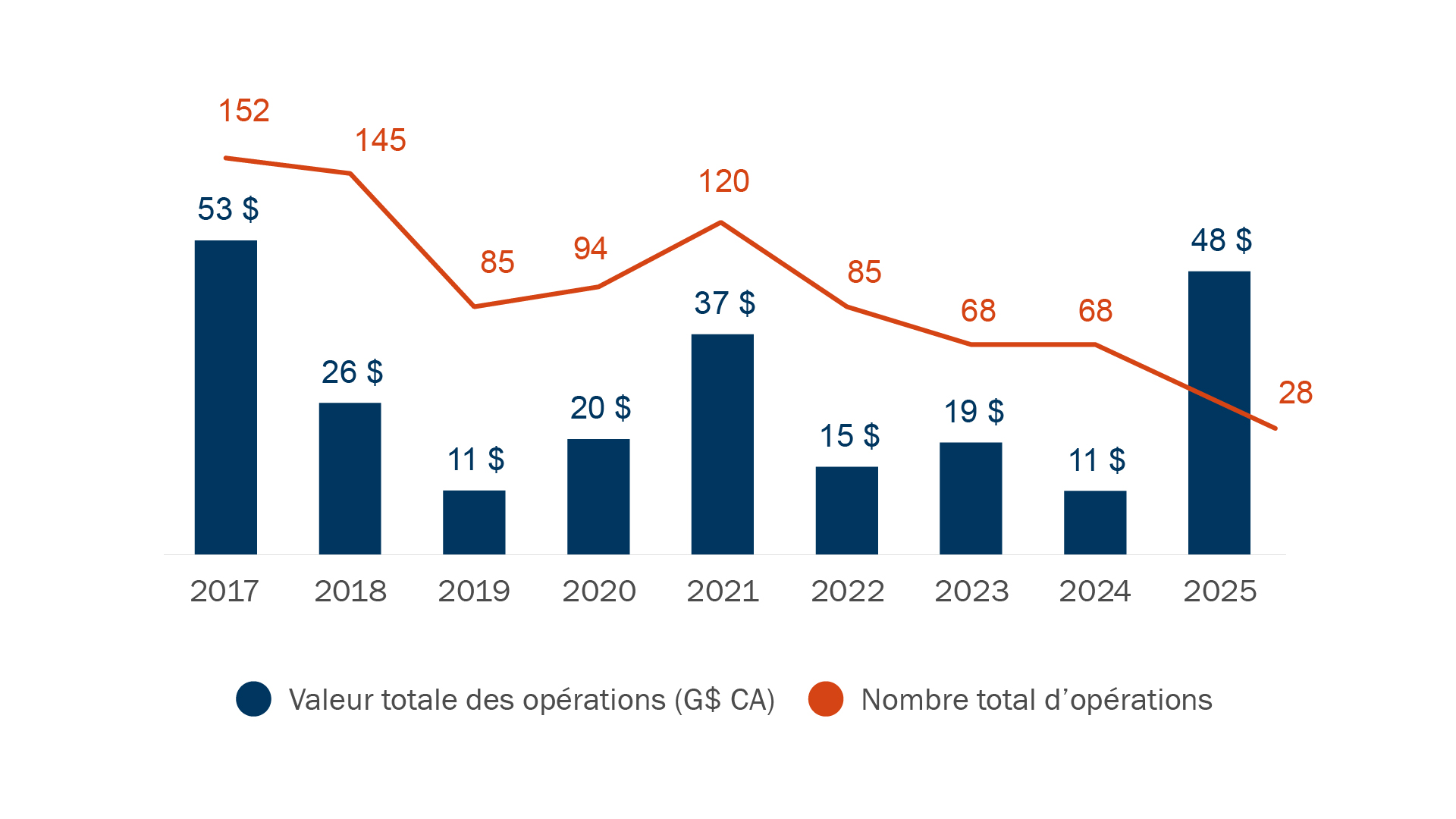
L’année 2025 a été une année faste en matière de fusions et acquisitions pour le secteur pétrolier et gazier canadien. La valeur totale des opérations s’est chiffrée à 48 milliards de dollars canadiens, le montant le plus élevé en huit ans. Cette valeur est plus du quadruple de celle de l’année précédente, bien que le nombre d’opérations ait quant à lui diminué (voir la figure 1).
Figure 1 : Valeur des opérations de fusions et acquisitions dont les cibles sont des sociétés pétrolières et gazières canadiennes
Comme nous l’avons décrit dans un article précédent, « 2026 sera-t-elle l’année des fusions et acquisitions dans les secteurs des infrastructures et de l’énergie au Canada? », les opérations dans le secteur de l’énergie ont principalement découlé d’enjeux de regroupement stratégique, les entreprises cherchant à générer des synergies et à croître. Après plusieurs années de regroupements dans le secteur, cinq entreprises représentent aujourd’hui 85 % de la production de sables bitumineux de l’Alberta1.
Les pressions géopolitiques redéfinissent la stratégie énergétique
La volatilité géopolitique actuelle continue de façonner l’avenir de l’exploitation des ressources et le contexte dans lequel s’inscrivent les opérations du secteur pétrolier et gazier du Canada. Dans la foulée de l’escalade des tensions commerciales avec les États-Unis en 2025, Ottawa s’est engagé à doubler ses exportations vers les pays autres que les États-Unis d’ici à 2035. Comme la majorité des exportations de combustibles fossiles du Canada ont toujours été dirigées vers le sud et que l’industrie pétrolière et gazière représente environ le quart des exportations totales du Canada, la diversification des partenaires commerciaux en matière de combustibles fossiles est devenue une priorité nationale.
Pour s’attaquer aux enjeux nationaux de sécurité et de souveraineté énergétiques, les gouvernements fédéral et provinciaux ont lancé une série d’initiatives visant à simplifier les échéanciers pour les projets, à encourager les investissements privés et à mener à terme un plus grand nombre de projets prioritaires nationaux, notamment dans le cadre de la Loi visant à bâtir le Canada et du budget 2025.
Dans le contexte géopolitique actuel, le Canada reconnaît le potentiel du secteur des ressources du pays et redéfinit la manière dont il commercialise et transporte son énergie. Le pétrole et le gaz naturel liquéfié (GNL) canadiens s’écoulent de plus en plus vers les marchés d’Asie, avec lesquels le Canada a cherché à resserrer ses liens. Nous examinons en détail ces interrelations dans notre article consacré aux occasions que présente le GNL au Canada.
Parmi les annonces récentes, on peut citer le partenariat stratégique conclu en mars 2026 entre le Canada et l’Inde, qui prévoit un engagement plus soutenu en matière de gaz de pétrole liquéfié (GPL)2. En janvier 2026, le Canada et la Chine ont signé un protocole d’entente selon lequel les deux pays s’engagent à renforcer leur coopération en matière de développement pétrolier et gazier et à accroître les échanges de pétrole brut, de GNL et de GPL3.
L’Alberta prévoit également de construire un oléoduc de classe mondiale en copropriété avec les peuples autochtones vers la côte ouest de la Colombie-Britannique, afin d’ouvrir l’accès aux marchés asiatiques et de renforcer la souveraineté énergétique du Canada4. Dans le cadre d’un protocole d’entente très médiatisé avec l’Alberta, le gouvernement fédéral a accepté d’envisager que l’oléoduc soit un projet d’intérêt national. Il ne faut pas non plus perdre de vue l’importance du marché américain. Il y a actuellement une proposition visant à remettre en fonction certaines parties de l’ancien oléoduc Keystone XL5.
Il demeure cependant difficile de concilier le développement de grands projets avec les ambitions climatiques du Canada. Le protocole d’entente entre le Canada et l’Alberta demande à la province d’augmenter sa taxe sur le carbone industriel et de s’engager à développer le projet de captage et de stockage de carbone Pathways Plus. Les gouvernements fédéral et provincial sont toujours en négociation, et les producteurs du secteur attendent les résultats de ces discussions avant de prendre des décisions d’investissement, car ces décisions reposent sur une bonne compréhension des structures de coûts et des rendements potentiels. L’interdiction pour les pétroliers d’amarrer ou de mouiller prévue par le projet de loi C-48, la Loi sur le moratoire relatif aux pétroliers, entrave également le potentiel d’exportation du pétrole vers les marchés asiatiques et la viabilité d’un nouvel oléoduc. L’avenir du projet de loi reste incertain.
Quel avenir pour les fusions et acquisitions?
On s’attend à ce que le rythme des opérations dans le secteur pétrolier et gazier canadien demeure stable, mais il reste à voir si les méga-opérations se chiffrant en milliards continueront à dominer. Les grandes opérations de fusion et d’acquisition pourraient ralentir en raison du nombre restreint de cibles de premier plan restantes à la suite des récentes années de regroupement ainsi que de l’incertitude quant aux prix des produits de base à long terme.
L’Ouest canadien reste un acteur de premier plan dans le domaine des exportations canadiennes de pétrole et de gaz, et l’on s’attend à ce que la région intéresse davantage les investisseurs étrangers en 2026. Le bassin de Montney en particulier a été une cible de choix des récentes activités de fusions et acquisitions, représentant à lui seul environ 30 % des opérations du secteur pétrolier et gazier au Canada en 2025. Selon Reuters, les producteurs américains à la recherche de nouvelles zones de forage cherchent à étendre leurs activités dans ce bassin, où l’acquisition de terrains est moins coûteuse que dans le bassin permien6.
La participation financière des Autochtones aux projets énergétiques canadiens transforme le paysage des transactions et des investissements. En plus de respecter l’obligation de consulter et de promouvoir la réconciliation économique, le Canada encourage une participation significative des groupes autochtones au capital des grands projets par l’intermédiaire du Programme de garantie de prêts pour les Autochtones7, dont l’enveloppe se chiffre à 10 milliards de dollars, auquel s’ajoutent d’autres programmes de garantie de prêts provinciaux. Nous examinons de près ces partenariats dans l’article « Participation des communautés autochtones au capital de grands projets au Canada ».
À quoi s’attendre pour la suite
La situation géopolitique actuelle rend la stabilité et la pérennité de l’offre canadienne de pétrole et de gaz du Canada très attrayante sur les marchés mondiaux. Il y a un immense potentiel de développement de la production et des exportations d’énergie du pays au moyen d’investissements et d’ententes.
Compte tenu de la richesse de ses ressources et des inquiétudes suscitées par la faible croissance de son PIB, le Canada se trouve aujourd’hui dans une situation où il dispose à la fois de la dynamique politique et de l’intérêt international nécessaires pour tirer parti des occasions qui s’offrent à lui dans cette période charnière. La voie à suivre repose sur la création d’un environnement réglementaire stable offrant une plus grande certitude en matière de coûts pour les investisseurs, la conclusion de partenariats reconnaissant les groupes autochtones comme des participants à part entière et la continuité de l’engagement international. En s’alignant sur ces priorités, le Canada peut répondre à la demande mondiale urgente en énergie et s’imposer comme un fournisseur mondial stable de pétrole et de gaz, à l’image d’une véritable superpuissance énergétique.
- The Globe and Mail, « Canada's second chance in the global LNG race », 13 mars 2026.
- Premier ministre du Canada, « Le premier ministre Carney noue un nouveau partenariat ambitieux avec l’Inde qui porte sur l’énergie, les talents et la technologie », 2 mars 2026.
- Gouvernement de l’Alberta, West Coast Oil Pipeline.
- BOE Report, « Canadian oil tycoon backs South Bow pipeline to boost US exports », 9 mars 2026.
- Reuters, « Canada’s hottest shale play is catching the eye of US producers », 18 décembre 2025.
Si vous souhaitez discuter ces enjeux et ces questions, veuillez contacter les auteurs.
Cette publication se veut une discussion générale concernant certains développements juridiques ou de nature connexe et ne doit pas être interprétée comme étant un conseil juridique. Si vous avez besoin de conseils juridiques, c'est avec plaisir que nous discuterons les questions soulevées dans cette communication avec vous, dans le cadre de votre situation particulière.
Pour obtenir la permission de reproduire l’une de nos publications, veuillez communiquer avec Bryn Turnbull.
© Torys, 2026. Tous droits réservés.