
The key trends shaping Canada’s mining industry in 2026
Authors







As Canada enters 2026, mining project development is evolving amid accelerated permitting initiatives, increased consolidation and transactional activity, and growing national‑interest considerations in foreign investment reviews. In the wake of a changing geopolitical landscape, Canada has also released its first Defence Industrial Strategy, which may further bolster metals and mining activity for critical minerals essential for defence.
We review the top developments changing the mining industry landscape across Canada, from new policy frameworks to market dynamics shaping project partnerships, structures and financing.
1. Permitting
Over the next year, several project acceleration initiatives put forward by federal and provincial governments alike will be put to the test; in many cases, it will be the first time a new regulatory framework is implemented. Canada’s mining sector stands to benefit from these reforms not only to speed up project timelines but also to enhance regulatory certainty and investor confidence.
Federal initiatives
Federally, in 2025, the Building Canada Act established a new Major Projects Office (MPO) aimed at accelerating nationally significant projects by streamlining federal approvals, coordinating financing and acting as a single point of contact for proponents, governments and Indigenous peoples. The Government of Canada has, to date, “referred” 13 projects to the MPO1, five of which are mining projects2. The MPO has also been asked to focus its attention on the federal Critical Minerals Strategy, among other transformative strategies focused on specific sectors and regions. The Building Canada Act also allows the government to designate projects as being in the national interest to fast-track or, in some cases, by-pass federal approvals and permits, although no project has been formally designated as a “national interest project” at the time of writing. We expect scrutiny over the MPO’s work to intensify in 2026. Notably, the Impact Assessment Agency of Canada (IAAC) also continues to make headway on its goal to streamline approval timelines, with 21 mines and minerals projects currently “in progress” to receive federally designated status for impact assessment.
Provincial initiatives
Provincially, governments are mirroring the federal shift and have adopted new legislation to cut regulatory red tape and shorten review times. British Columbia’s Infrastructure Projects Act extends faster permitting pathways to “provincially significant” projects, which include projects that contribute to the province’s “critical mineral supply” or “energy security”. In Ontario, the Protect Ontario by Unleashing Our Economy Act received Royal Assent, which aims to overhaul the project permitting regime by establishing streamlined processes and new Special Economic Zones, including for mining projects. Similarly, the Québec government introduced a bill in December 2025 that would allow priority projects to undergo a single authorization, covering dozens of environmental and resource management laws3.
2. Transactions
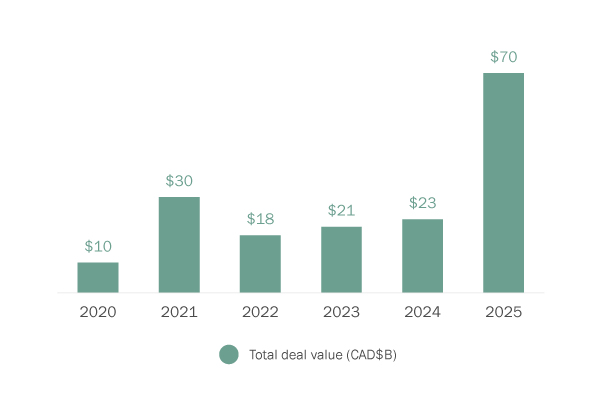
The mining space is being influenced by three key transactional trends in the M&A and equity financing space: (1) consolidation; (2) disposition of non-core assets; and (3) the increasing use of joint venture and partnership structures. These market dynamics helped drive mining and metals deal values to their highest levels in the past six years, totalling $70 billion for 2025 (see Figure 1).
Figure 1: M&A deals with Canadian metals and mining targets
Consolidation
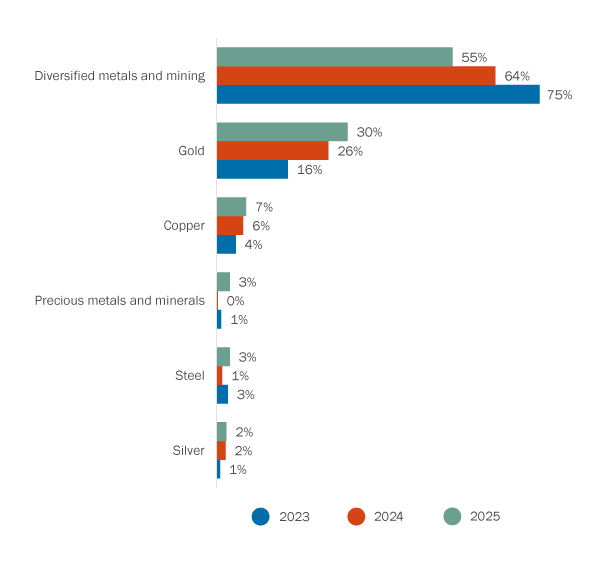
Consolidation is a theme across the mining sector, impacting both base and precious metals, with an emphasis on critical minerals, particularly copper. The US$57 billion Anglo Teck merger of equals is the leading example of this trend4. Companies are seeking combinations to optimize complementary projects and unleash key synergies. This is the case for Anglo Teck with respect to Collahuasi and Quebrada Blanca II, where potential project synergies formed a key value driver for the transaction. The precious metals industry has also seen significant consolidation in the context of record-setting commodity prices. Record gold prices are helping drive this consolidation, with nine takeovers with a deal value of more than US$1 billion involving Canadian gold mining companies since the beginning of 2025 (see Figure 2).
Figure 2: Industry breakup of Canadian mining targets by deal count
Disposition of non-core assets
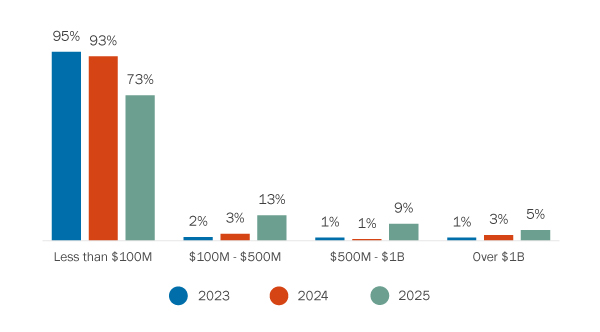
In the context of majors focusing on key assets and primary commodities, we are seeing a number of transactions where smaller players are acquiring non-core projects from larger companies, which contributed to the increase of deals in the middle market range (see Figure 3). These include existing companies and new vehicles being created for these opportunities, with dedicated management teams hoping to unlock underutilized or underdeveloped assets. These have the potential to revitalize historical production camps, such as Discovery Silver’s acquisition of the Porcupine Mine Complex from Newmont Corporation5 and Hemlo Mining Corporation’s acquisition of the Hemlo Mine from Barrick Mining Corporation.
Figure 3: Mining transactions by deal value
Joint venture and partnership project development structures
We are also increasingly seeing mining companies finding creative ways to partner together in joint venture and partnership structures to develop projects. This approach to partnership includes greenfield project development and efforts to combine brownfield operations to extend mine life and increase production. Vale Base Metals and Glencore Canada’s recently announced transaction6 to evaluate a partnership to combine their operations in the Sudbury basin is a prime example of this trend, driven by high commodity prices, expected copper demand, and a desire to leverage existing assets and infrastructure. Desire for exposure to critical minerals is dovetailing with operators seeking to derisk project development and expansion, leading to an increase of partnerships and joint ventures.
3. Indigenous engagement
Advancing the interests of Indigenous peoples is one of several factors set out under the Building Canada Act, which must be considered when designating a project under the Act. This reflects the central importance of addressing Indigenous rights, related consultation duties, and broader engagement on Indigenous interests as a key success factor for projects in 2026. For any project designated to proceed under the Act, Indigenous consultation must take place both before a project is designated as a national interest project and throughout the course of the project development and permitting, in advance of the responsible minister issuing a conditions document. The conditions document constitutes federal government approval and would include appropriate mitigation and accommodation measures. For projects proceeding through ordinary regulatory processes, including those “referred” to the MPO but not designated under the Act, Indigenous consultation and appropriate accommodation will need to take place in order to obtain key government approvals.
Further, the United Nations Declaration on the Rights of Indigenous Peoples (UNDRIP) and its principles of Free, Prior and Informed Consent (FPIC) will continue to influence how mining projects are pursued in Canada. The Courts of British Columbia and the Federal Court of Appeal are currently considering the manner in which UNDRIP and FPIC may influence the duty to consult and accommodate in Canadian law (for more on this, please refer to our discussion of these cases). Understanding the continuing evolution of FPIC in Canadian law and practice may help facilitate project development and plans for robust Indigenous consultation and engagement. This both advances direct project-related engagement with potentially affected Indigenous peoples and assists with indirect matters (such as reducing hurdles for project-related lending).
4. Foreign investment review
Dealmakers will be mindful of the potential effects of the evolving macroeconomic and geopolitical environment on their transactions heading into 2026. Foreign investments will bring additional complexity to transactions, with the Government of Canada looking to strike the right balance between (1) enhanced reviews for foreign investors in certain Canadian businesses (particularly in resources, energy, critical minerals and infrastructure projects); and (2) bolstering Canada’s standing on the global stage as a place to attract capital and do business. As such, enhanced scrutiny under the Investment Canada Act may contribute to longer deal timelines; however, these timelines could be accelerated where the government feels that certain deals are aligned with the national interest (as was the case in Anglo Teck). As such, having strategic clarity at the outset of a deal (i.e., a compelling rationale as to why a deal is in the public interest) may help foreign investments across the finish line in the current environment of shifting trade relations and geopolitical uncertainty.
- While 13 projects have been referred to the MPO, none of these 13 projects, or any other project to date, has been formally designated to trigger the priority legislative scheme in the Building Canada Act.
- Canada Nickel’s Crawford Project in Ontario, Nouveau Monde Graphite Matawinie Mine in Québec, the Red Chris Mine Expansion in British Columbia, the Northcliff Resources’ Sisson Mine in New Brunswick and the McIlvenna Bay Foran Copper Mine Project in Saskatchewan.
- However, it is uncertain whether this bill will become law before the next Québec election, which is scheduled for October 5, 2026.
- Torys is acting for Anglo American plc on this transaction.
- Torys acted as counsel to Franco-Nevada in the provision of US$450 million of a comprehensive financing package made available to Discovery Silver Corp. to enable the acquisition of the Porcupine Gold Complex in northern Ontario from Newmont Corporation and to support the subsequent development of the complex.
- Torys is acting as counsel to Vale Base Metals in its negotiation of an agreement with Glencore Canada Corporation to jointly evaluate development of a copper project at adjacent properties in the Sudbury Basin in northern Ontario, including the framework for the establishment of a 50/50 joint venture to develop any resulting project.
To discuss these issues, please contact the author(s).
This publication is a general discussion of certain legal and related developments and should not be relied upon as legal advice. If you require legal advice, we would be pleased to discuss the issues in this publication with you, in the context of your particular circumstances.
For permission to republish this or any other publication, contact Bryn Turnbull.
© 2026 by Torys LLP. All rights reserved.