
US cross-border M&A: mid-year outlook



All dollar amounts in this article are US$.
US M&A deal environment
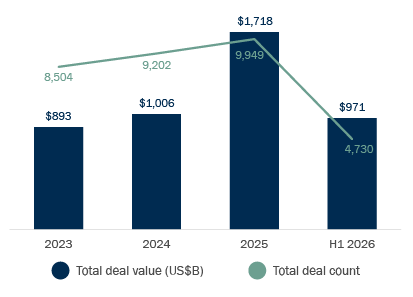
US M&A activity surged in the first half of 2026, driven in large part by megadeals, the AI buildout and dealmakers who have become more comfortable with uncertainty. A lighter regulatory touch also added to the momentum. In H1 this year, the total value of deals between US acquirers and US targets is 49% higher ($319 billion) on 2% fewer transactions compared to H1 2025. US M&A has increased year-over-year in both deal value and deal count since 2023 (see Figure 1). Globally, transaction values were up about 30% in the first six months of the year—putting deal activity on course to potentially pass its record haul in 20211.
This outsized start to the year comes despite geopolitical headwinds, a disrupted global energy market and the reemergence of inflationary pressures. There are similarities to the six months of 2025 when trade tensions and Liberation Day delivered an unexpected jolt of volatility to the market. But unlike last year, companies and investors in the US have continued to transact in an environment where the M&A pipeline continues to be strong and the conditions for dealmaking remain in place.
The massive capital deployment and sheer scale of the AI buildout is reverberating across the US M&A landscape. AI is spurring dealmaking in an ever-widening range of sectors and is changing the way some companies look at M&A. Assessing how AI will affect the long-term valuation of a business is becoming increasingly important.
Globally, foreign acquirers continue to find US targets attractive. Canada remains a leading source of deal flow to the US, although activity has slowed somewhat after a busy 2025. Japan leads Asian countries in dealmaking with the US and Canada, with India becoming increasingly active.
Figure 1: US M&A (US acquirers of US targets)
US M&A: Sector breakdown
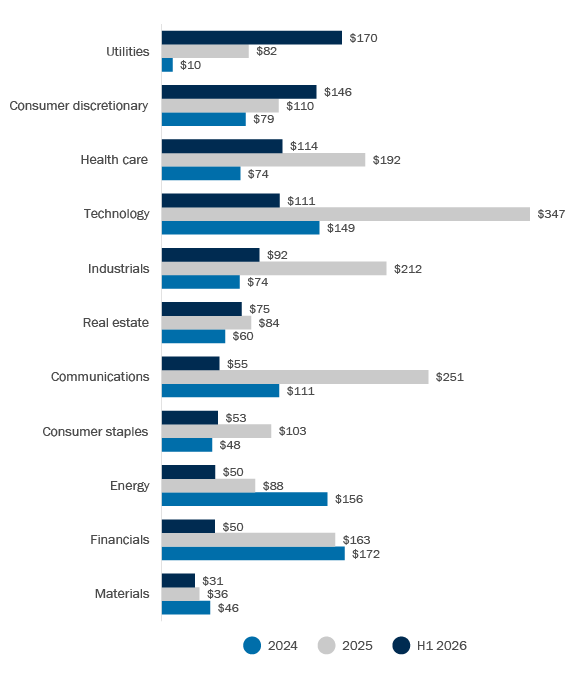
Utilities and consumer discretionary are leading the way in US M&A in H1 2026, as measured by deal value (see Figure 2). Both sectors have already exceeded their FY totals from 2025. Health care is on track to surpass last year’s dealmaking performance in value and deal count. Industrials and real estate also had strong starts to the year. Consumer staples is holding steady and energy has picked up after declining in deal value in 2025.
NextEra Energy Inc.’s $119 billion acquisition (including debt) of Dominion Energy Inc. accounts for much of the increase in the utilities sector. It is the largest utility acquisition in US history and highlights the importance of scale to accommodate the power demand driven by artificial intelligence2. Technology deal value fell by 27% in the first half of this year compared to H1 2025. Starting in late January this year, the announcement of new AI tools led to a selloff in software stocks, which slowed deal flow in technology. In the health care sector, the value of biopharma M&A has jumped in 2026 as large drugmakers are racing to scoop up biotechs with promising medicines to replenish revenues as their older drugs lose patent protection3.
Figure 2: Sector breakdown (US acquirers of US targets in US$B)
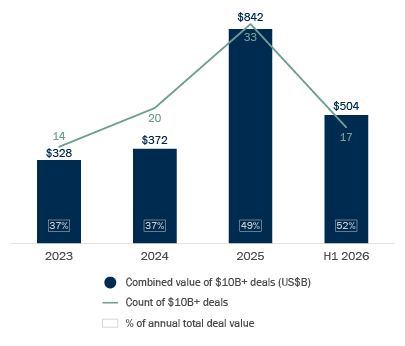
The trend of megadeals continues to gain momentum in 2026 (see Figure 3). The number of transactions valued at $10 billion or more now accounts for over half of the aggregate deal value so far this year. Megadeals have been growing in recent years and spiked in 2025. The remainder of 2026 is on track to exceed last year’s total. Globally, companies struck 38 deals valued at $10 billion or more in the first half of the year, the most ever in a six-month period4.
Figure 3: Megadeals (US acquirers of US targets)
AI M&A
One of the driving factors behind the trend of megadeals is the push for scale in the AI buildout. Data centers and the power required to operate them require massive amounts of capital and industrial capacity, and this need is being met in part by ever-larger M&A transactions. The top four hyperscalers in the United States—Google, Microsoft, Meta Platforms, and Amazon—announced they plan to spend $725 billion on capex this year, mainly on data center infrastructure. This is up from $376 billion in 2025.
Mergers and acquisitions are coming in a wide range of industries in response to this wave of investment—from technology to energy, infrastructure, real estate and manufacturing. Deal activity is spanning both public and private capital, with the largest private equity firms and Canadian and global institutional investors announcing deals and investments in data centers, power grids, renewable energy and the picks-and-shovels of the buildout.
As mentioned earlier, AI is influencing how the long-term valuation of a business is determined. Valuations can hinge on how meaningfully a company has integrated AI into their products, if a sector or business model is prone (or resilient) to AI disruption, and the data and client networks a company holds. AI native enterprises, which are built from the ground up with AI at their core, are seeing rapid growth in valuations.
Global deal flows
Inbound US M&A
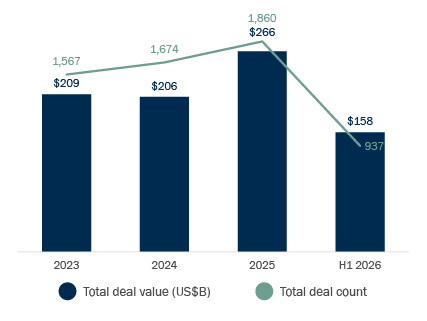
The total value of foreign acquisitions of US targets in H1 2026 is $52 billion higher than in the first half of last year and deal count is slightly up. Canada is the top foreign acquirer in 2026 by number of deals. The UK leads the way in total M&A value at $24.8 billion followed by France at $19 billion, as transatlantic dealmaking booms. Japan was third in both deal value and deal count. Globally in H1 2026, cross-border M&A had its best annual start since 2018. The US was the most targeted, accounting for 25% of global cross-border transactions5.
Figure 4: Foreign acquisitions of US targets
Investment from Canada into the United States
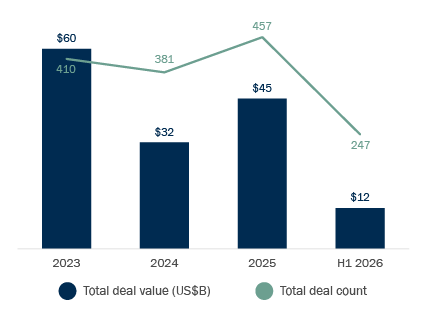
Canadian acquisitions of US targets have declined in deal value and rose by deal count so far in 2026 (see Figure 5). Deal activity rebounded in 2025, which was a positive development as the Canadian economy felt the impacts of US tariffs. In a widely anticipated decision, the US administration declined to renew the United States-Mexico-Canada Agreement (USMCA) on July 1, 2026. The agreement now moves into a period of annual reviews. Trade negotiations are expected to continue and a constructive resolution of the USMCA would remove one of the biggest sources of uncertainty for Canadian dealmakers interested in opportunities south of the border.
Figure 5: Canadian acquisitions of US targets
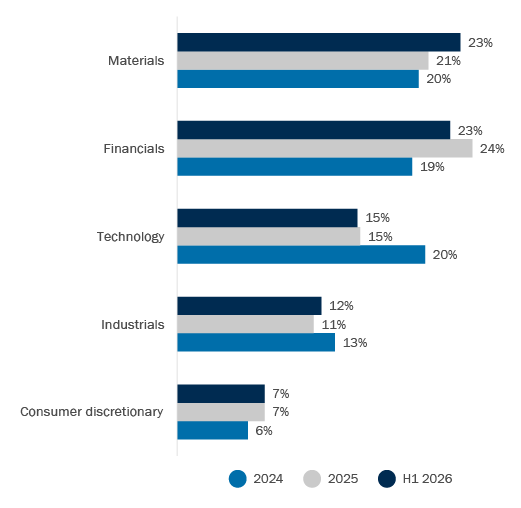
Canadian companies in the materials, financials, technology and industrials sectors account for the bulk of US acquisitions by number of deals (see Figure 6). In H1 2026, these four sectors were responsible for 73% of all outbound deals to the US, and this trend has held fairly steady in recent years. Dealmaking in financials has increased the most since the start of 2024 and technology has seen the largest decline.
Real estate is the most active sector in 2026 by total value with $5.4 billion worth of deals. This includes the two largest transactions so far this year. Materials is second with $2.8 billion in value and also has the second highest number of deals.
Figure 6: Canadian acquirers of US targets (sectors as a % of total deal count)
The number of $1 billion-plus Canadian acquisitions of US targets declined in the first half of this year, both in the number of deals and as a percentage of total annual M&A value. Billion-dollar-plus deals made up 90% of deal value in H1 2025—compared to 65% in 2026. The proportion of deals valued between $100 million and $500 million increased from 6% in the first six months of 2025 to 19% this year.
Investment from the United States into Canada
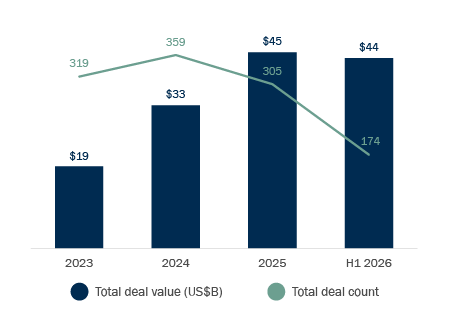
US acquisitions of Canadian targets have steadily risen by deal value in recent years, and 2026 has almost exceeded last year’s total (see Figure 7). Two $15 billion-dollar-plus deals in Q2—one for natural gas assets and one for an LNG project—propelled energy M&A to $32 billion in H1 2026. Total deal value for energy was a combined $10 billion in 2024 and 2025. US acquisitions are getting bigger in other sectors too. Of the ten largest announced or completed deals since the start of 2023, eight took place in 2025 or 2026.
Figure 7: US acquisitions of Canadian targets
Technology and industrials have accounted for the highest number of US acquisitions of Canadian targets in recent years. These sectors have ranked in the top two spots by deal count since 2023, followed by consumer discretionary.
Asian M&A
Asian M&A with Canada and the US is a story of Japan’s booming market, activity with India on the rise, and a slowdown in dealmaking with China.
Both outbound and inbound M&A between Japan and Canada/US hit recent highs in 2025 and activity is on pace to exceed last year’s totals (see Figure 8). Japan’s M&A market had a record-breaking 2025 as total transaction volume nearly doubled to close to $400 billion—and this could be topped in 20266. Economic fundamentals are strong in Japan, business confidence is high, activist pressure from shareholders has been growing, and Japanese companies continue to seek dealmaking opportunities overseas, despite the weak yen.
Figure 8: M&A deal activity: Japan and Canada/United States

The number of Indian acquisitions of Canadian and US targets has been growing gradually in recent years, averaging $8 billion a year from 2023 to 2025. Deal value shot up to $17 billion in H1 2026 with Sun Pharmaceutical’s acquisition of Organon for almost $12 billion, in one of the biggest outbound deals by an Indian company7. Canadian and US acquirers have targeted India more than any other Asian country by number of deals from 2023 to 2026.
The pace of outbound M&A activity from Canada and the US to China slowed in 2025 and 2026, amid heightened trade and political tensions with the United States. Inbound deal activity from China fell by deal count and rose by value in 2026 on the strength of a $4 billion dollar acquisition of a Canadian mining company. Dealmaking between Canada and China could pick up in 2026 as the Canadian government works to recalibrate the relationship and increase economic activity between the two countries.
Looking ahead
The dealmaking momentum in the US and global markets in 2026 is expected to continue in the second half of the year. Companies and investors have grown more comfortable operating in an uncertain macro environment, and this increased confidence is helping to sustain activity even amid geopolitical and economic volatility.
The AI buildout will remain a powerful catalyst, broadening the M&A landscape across a wider range of sectors and creating demand for new types of strategic partnerships, acquisitions and infrastructure deals. The trend toward megadeals will likely persist as scale becomes increasingly critical. A relaxed regulatory environment in the US is adding to dealmakers’ confidence.
Canada-US M&A will remain a cornerstone for both markets, supported by deep economic ties, while Canada also looks to expand into global markets to diversify growth. Dealmaking with Japan is gaining momentum and stands as a promising and evolving opportunity to watch.
- Bloomberg, “Global M&A Tops $2.5 Trillion After First Half Deals Surge,” (July 1, 2026).
- Bloomberg, “NextEra-Dominion deal signals era of AI utility mega-mergers,” (May 18, 2026).
- Bloomberg, “Sun Pharma, Eli Lily lead latest rush of healthcare M&A,” (April 27, 2026).
- Bloomberg, “Global M&A Tops $2.5 Trillion After First-Half Deals Surge,, (July 1, 2026).
- Reuters, “Mega deals fuel record M&A as boards dream on big takeovers,” (July 1, 2026).
- Bloomberg, “Asia Outpacing 2021 Boom With $800 Billion M&A Haul,” (July 2, 2026).
- Bloomberg, “India’s Sun Pharma plots $12 billion Organon buyout for global reach”, (April 26, 2026).
To discuss these issues, please contact the author(s).
This publication is a general discussion of certain legal and related developments and should not be relied upon as legal advice. If you require legal advice, we would be pleased to discuss the issues in this publication with you, in the context of your particular circumstances.
For permission to republish this or any other publication, contact Bryn Turnbull.
© 2026 by Torys LLP. All rights reserved.