
Canada’s financial services M&A and capital markets in 2026




Canadian financial services M&A has remained resilient in 2026, even as transaction volume has moderated. Larger transactions represent a greater share of announced activity and buyers are increasingly using equity consideration. At the same time, Canada’s capital markets are keeping pace, with debt and equity markets continuing their year-over-year growth, maple bonds experiencing a historic demand, and IPO activity steadily climbing. We look at what this means for companies and capital and what’s on the horizon in the final quarter of 2026.
Canadian financial services M&A
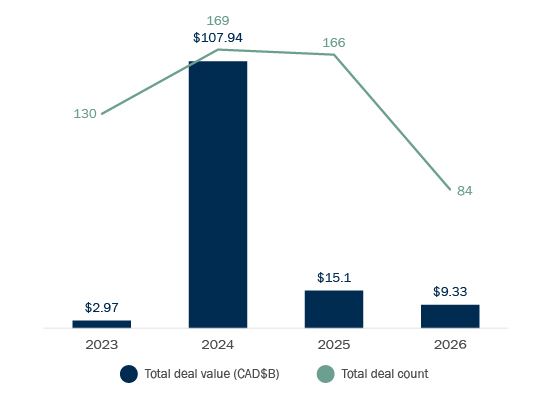
M&A activity in the Canadian financial services sector remained comparatively resilient through the final weeks of Q3. There have been 84 deals worth $9.33 billion as of September 15, 2026, compared to 111 transactions valued at $10.18 billion during the same period last year. While Canadian deal value is down modestly year over year, transaction volume fell more significantly, indicating a greater concentration in larger deals. This decline is also less pronounced than the 30% decrease across the North American finance sector1.
It remains to be seen whether 2026 will match the $15.1 billion in deal activity from FY 2025 with the final quarter of the year now underway (see Figure 1).
Figure 1: Canadian financial services transactions 2023 – 2026
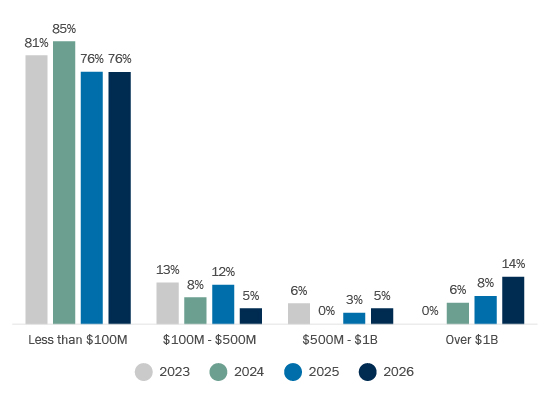
In 2026, there has been a continued increase in the proportion of financial services deals valued at over $1 billion (see Figure 2). Among transactions with disclosed values, these transactions have accounted for 14% of market activity so far this year, up from 8% in 2025 and 6% in 2024. Deals under $100 million represented 76% of market activity, unchanged from 2025, but down from 85% in 2024.
Figure 2: Canadian financial services targets 2023 – 2026
The makeup of financial services M&A has shifted materially in recent years. Deals involving asset managers and custody banks have more than doubled as a share of overall activity, rising from 29% in 2023 to 60% in 2026. Over the same period, insurance brokers accounted for a smaller share of deal activity, as consolidation and the move towards larger scale has been reshaping the industry. While 59% of all deals in 2023 involved insurance brokers, that figure has fallen to 26% so far in 2026.
The form of consideration offered to financial services targets is also evolving. Common equity has become increasingly prevalent, rising from 51% of all deals in 2023 to 65% in 2026. Meanwhile, cash consideration has declined for two consecutive years, and now accounts for 20% of annual transactions, down from 38% in 2024.
A notable financial services transaction in 2026 has included Bank of Montreal (BMO) and Royal Bank of Canada (RBC) agreeing to sell Moneris Solutions Corporation to Francisco Partners Management, LP for approximately $2 billion, with BMO and RBC each receiving a 50% share. In March, Everest Group, Ltd. agreed to sell its Canadian retail insurance operations to the Wawanesa Mutual Insurance Company. The completion of the sale was announced on October 1, 2026.
Record maple bond issuance
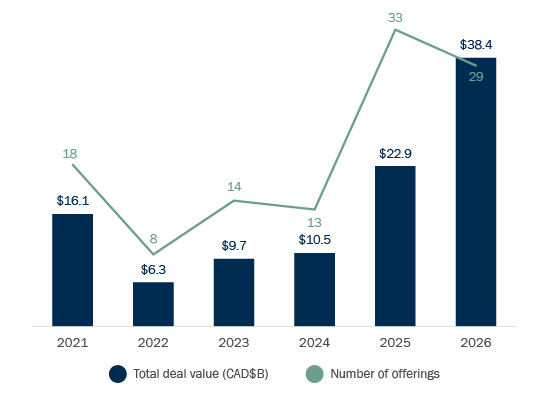
The unprecedented demand by foreign borrowers for maple bonds has been one of the stories of the year in Canada’s capital markets. Issuance of the Canadian-dollar-denominated bonds hit an all-time annual high in June, and the total for 2026 now stands at $38.4 billion. This tops the previous record of $22.9 billion in 2025. The number of offerings is also on track to exceed last year’s total (see Figure 3).
Figure 3: Maple bond offerings, 2021 – 2026
This surge has been driven in large part by US hyperscalers looking to diversify their funding of the AI buildout. Maple bonds have also benefitted from their inclusion in the FTSE Canada Universe Bond Index as of January 1, 2025.
In June 2026, Amazon issued $14 billion of maple bonds in a five-part deal, the largest-ever Canadian-dollar-denominated corporate bond offering. One month earlier, Alphabet had set a then-record by selling a $8.5-billion, four-part offering. Several other large US companies have tapped Canada’s maple bond market and its lower borrowing costs in 2026, including three separate offerings, each worth more than $2 billion.
The insatiable demand for capital to build AI infrastructure is a global phenomenon that is being felt in debt markets around the world. In August 2026, Alphabet sold A$5.5 billion of debt in its debut Australian-dollar bond offering, helping drive Kangaroo bond issuance towards a record high2. Amazon raised €14.5 billion in March in the largest-ever deal in the euro corporate bond market. The Financial Times reports that hyperscalers will likely continue to tap the European bond market this autumn3.
Canadian corporate debt activity
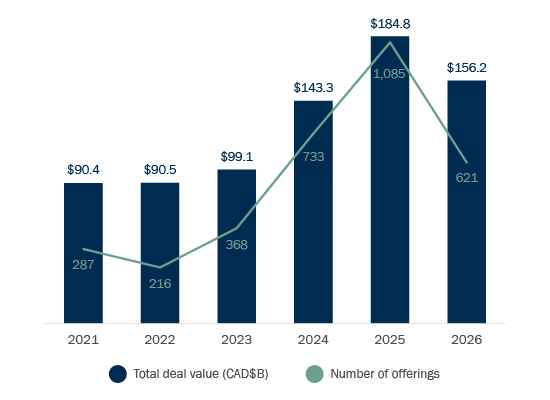
Canada’s corporate debt market continues to be robust, with companies issuing $156.2 billion in corporate bonds in 2026 (as of September 15). That total represents 85% of the $184.8 billion raised during 2025, although the pace of issuance moderated as the third quarter progressed. Between 2021 and 2025, the annual value of corporate debt offerings in Canada more than doubled. The number of offerings over that same period rose dramatically as well, with a 278% increase from 2021 to 2025 (see Figure 4). While the total value of debt offerings year to date in 2026 remains high, similarly to some of the data we observe in M&A transactions, the total number of offerings has decreased by 17% compared to the same period in 2025.
Figure 4: Canadian corporate debt offerings, 2021 – 2026
Banks and financial firms remain at the forefront of debt issuance activity in Canada in 2026, placing first and third respectively, by total issuance volume. Banks have raised $57 billion through 410 offerings this year, and financial companies have raised $20 billion across 57 offerings. Together, this accounts for 49% of all debt issued by value and 75% of total offerings, underscoring their central role in Canada's debt capital markets.
Canadian equity markets
Canadian equity markets have seen a steady increase over the last three years, with companies raising $25 billion through 158 follow-on offerings and IPOs in the first nine months of 2026. Total deal value has surpassed last year's level, and is 67% higher than the $15 billion raised in 2023, but is down 38% from the high-water mark of $40 billion raised in 2021 (see Figure 5).
Figure 5: Canadian equity offerings, 2021 – 2026
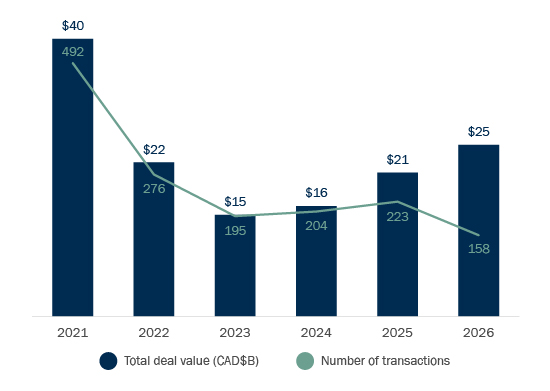
Following several subdued years, Canadian companies have raised $3 billion through IPOs so far in 2026, with more than one-third of that activity coming from the healthcare sector. By comparison, IPO activity totaled $1.28 billion in 2025, and stayed below $500 million in both 2024 and 2023. The number of follow-on offerings has also been increasing steadily, rising 28% between 2023 and 2025.
Materials companies continue to account for a significant share of equity market activity, representing 61 of the 158 offerings completed this year. Healthcare, energy, and financial companies have combined to account for an additional 60 offerings. By capital raised, information technology leads the market with $5.64 billion, followed by healthcare at $5 billion, and energy at $4.98 billion.
Market drivers and looking ahead
Record maple bond issuance, strong and resilient debt markets, and a steady rise of equity financing provide a variety of financing options for issuers, while financial services mergers and acquisitions continue to support strategic consolidation. Demand for capital continues to be supported by investment in technology, infrastructure, and long-term growth initiatives, bolstered by the Canadian federal government’s plan to catalyze $1 trillion in total investment in Canada over the next five years.
The outlook is constructive across both dealmaking and capital markets, but market conditions nevertheless remain sensitive to interest rates, trade developments, and geopolitical uncertainty. Buyers, issuers, and boards that prepare in advance will be best placed to act when opportunities present.
- Mergermarket, “Megadeals propel M&A toward nine-month record despite third quarter slowdown” (October 1, 2026).
- Bloomberg, “How Kangaroo bonds are a new front in AI debt boom” (August 20, 2026).
- Financial Times, “AI hyperscalers are transforming debt” (September 29, 2026).