
Le vent dans les voiles : le contexte juridique des projets éoliens au Canada




L’industrie éolienne canadienne s’apprête à entamer une période de forte expansion. Le secteur de l’énergie éolienne terrestre connaît une croissance soutenue depuis plus de deux décennies et est devenu l’une des formes d’énergie renouvelable les plus développées et les plus évolutives du pays. Le secteur de l’énergie éolienne extracôtière dispose désormais des cadres réglementaires et des régimes de financement nécessaires pour que les premiers projets éoliens en mer du pays puissent voir le jour au cours de la prochaine décennie. Bien que l’énergie éolienne ne représente que moins de 8 % de la production d’électricité et moins de 1 % de l’approvisionnement énergétique total, elle est aujourd’hui la source d’électricité la moins coûteuse et celle qui connaît la croissance la plus rapide au Canada1.
Développement de projets d’énergie éolienne terrestre
Au Canada, le nombre de projets éoliens terrestres est passé de 8 parcs éoliens en 1998 à 337 en 2023, la capacité éolienne implantée dépassant actuellement les 15 gigawatts2. L’Ontario, le Québec et l’Alberta sont les principaux marchés éoliens du pays; à eux seuls, ils représentent plus de 80 % de la capacité éolienne en service au Canada3. La délivrance de permis pour les projets éoliens terrestres repose principalement sur les autorisations provinciales en matière d’environnement et d’aménagement du territoire, et peut également nécessiter des permis fédéraux liés à la protection des oiseaux migrateurs, des pêches et des espèces menacées. Dans certains cas, par exemple pour les projets menés sur des territoires domaniaux, une évaluation d’impact fédérale peut être exigée.
Figure 1 : Capacité éolienne, solaire et énergétique actuellement implantée au Canada
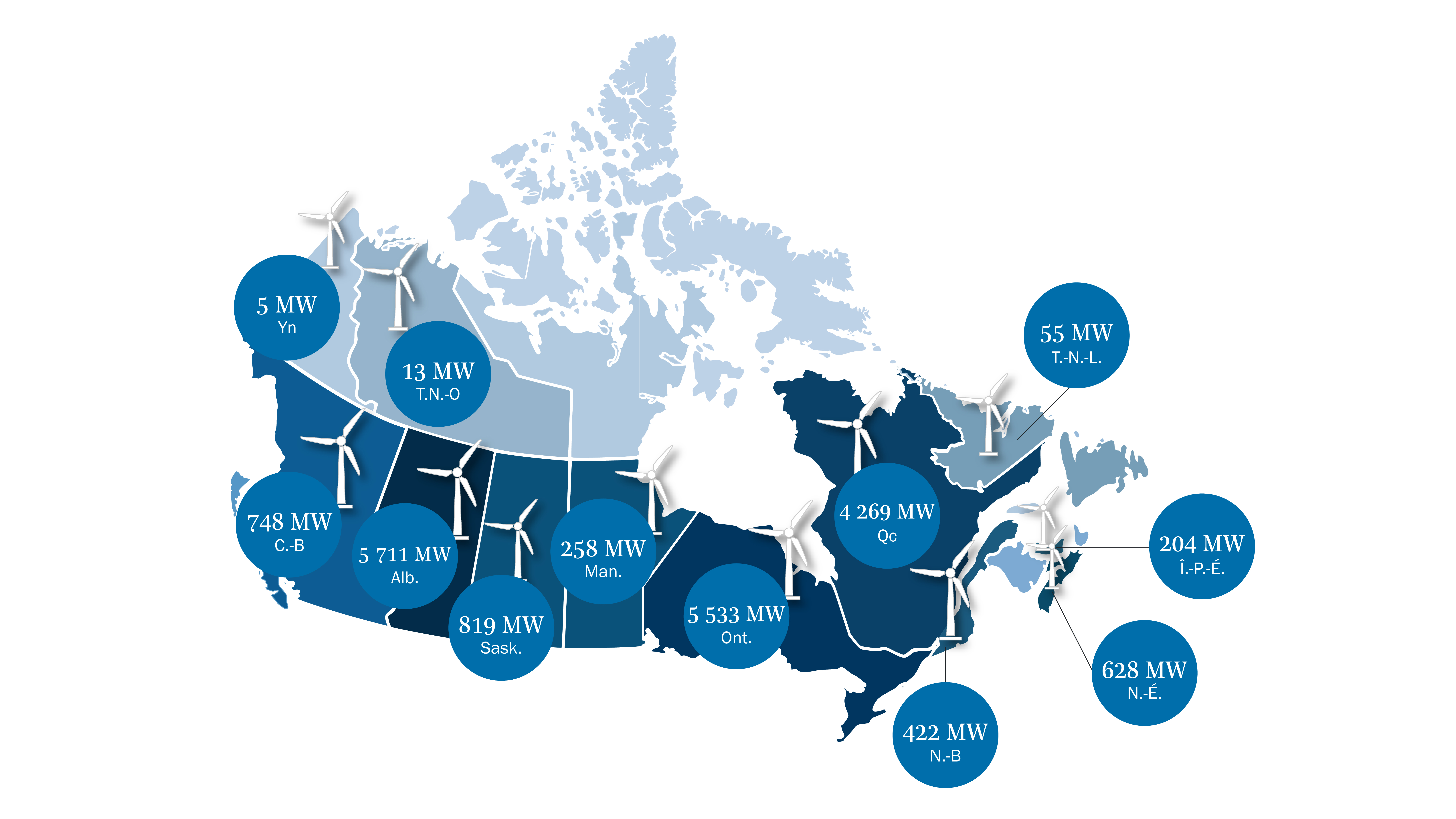
Ces dernières années, les acteurs qui possèdent, financent et contrôlent les projets éoliens au Canada ont changé. Les provinces établissent de plus en plus souvent des règles en matière d’approvisionnement qui favorisent les structures de partenariat, regroupant souvent des promoteurs, des services publics provinciaux, des municipalités ou des coopératives locales, ainsi que des communautés autochtones. Près d’un tiers des projets éoliens implantés au Canada sont désormais détenus en partie par des Autochtones, et comme les appels d’offres encouragent ou exigent une participation autochtone, ce chiffre devrait continuer à augmenter4.
Les obstacles au développement de nouveaux projets éoliens ne résident souvent pas dans les projets, mais plutôt dans les retards pris dans la mise en place des infrastructures de transport, de distribution et de stockage dans des batteries qui sont généralement nécessaires pour ouvrir la voie à de nouvelles possibilités de développement éolien. Les gouvernements fédéral et provinciaux du Canada déploient des efforts dans ce sens, mais il reste à voir si les nouveaux projets d’infrastructures de réseau parviendront à attirer les capitaux et à obtenir la certitude réglementaire nécessaire pour aboutir à une décision finale d’investissement. La nature de certains marchés provinciaux de l’électricité peut également constituer un obstacle aux nouveaux projets; par exemple, les marchés de gros déréglementés comme l’AESO5 ont, par le passé, favorisé les investissements des exploitants privés, tandis que d’autres marchés comme la SIERE6 se sont principalement appuyés sur les marchés publics, bien que des réformes du marché et de nouvelles initiatives soient prévues.
Développement de projets d’énergie éolienne extracôtière
En revanche, le Canada n’a encore aucun projet éolien en mer implanté ou opérationnel, alors qu’il dispose du plus long littoral du monde, de vents très forts et d’une grande expertise en matière d’énergies renouvelables. Il existe des possibilités tant sur la côte atlantique que sur la côte pacifique. Bien qu’il soit arrivé tardivement sur le marché mondial de l’énergie éolienne extracôtière, le Canada a mis en place, au cours des deux dernières années, de nouveaux cadres réglementaires et des régimes de financement, et a suscité un enthousiasme au sein du secteur qui pourrait permettre de mettre en œuvre ses premiers projets dans un avenir relativement proche.
L’organisme principal chargé de la réglementation du cycle de vie des projets éoliens en zone extracôtière est la Régie de l’énergie du Canada, à l’exception des zones faisant l’objet d’une réglementation conjointe avec les gouvernements provinciaux ou des projets relevant entièrement de la compétence provinciale7. En ce qui concerne les zones extracôtières de la Nouvelle-Écosse et de Terre-Neuve-et-Labrador, les gouvernements fédéral et provinciaux ont convenu de gérer conjointement l’exploitation des ressources extracôtières, y compris l’énergie éolienne, et de se partager les recettes qui en découlent. En 2024, le gouvernement du Canada a adopté une nouvelle loi visant à moderniser et à élargir les mandats des deux organismes de réglementation de l’énergie éolienne extracôtière dans la région de l’Atlantique, afin qu’ils ne se limitent plus au pétrole, mais englobent également les énergies renouvelables, et les deux provinces ont promulgué des lois de mise en œuvre correspondantes8. Pour les projets éoliens dans les eaux intérieures, comme les mers intérieures et les lacs d’eau douce, les gouvernements provinciaux sont les principaux organismes de réglementation du cycle de vie. Un nouveau projet éolien dans une zone extracôtière ou des eaux limitrophes avec 10 turbines ou plus, ou d’autres projets désignés par le gouvernement fédéral, doivent également faire l’objet d’une évaluation d’impact fédérale9.
Figure 2 : Zones désignées pour l’énergie éolienne en mer en Nouvelle-Écosse
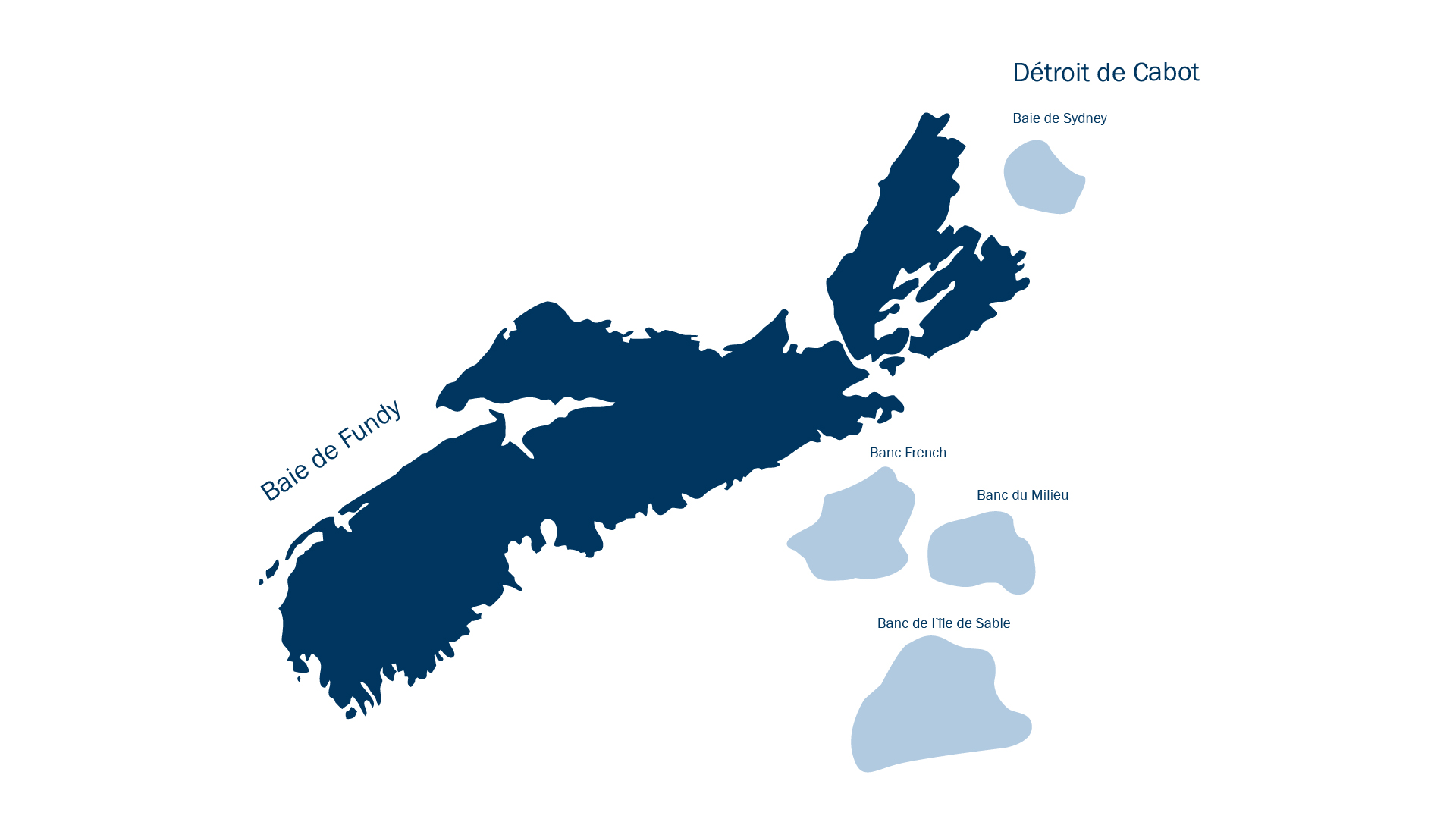
La Nouvelle-Écosse a joué un rôle de premier plan dans le développement des capacités éoliennes en mer en se fixant pour objectif d’autoriser une capacité de cinq gigawatts d’énergie éolienne extracôtière d’ici 2030 et en mettant en place le premier processus de délivrance de permis par appel d’offres du pays dans ce domaine. S’appuyant sur le rapport d’évaluation régionale achevé en janvier 2025, le Canada et la Nouvelle-Écosse ont mené une vaste consultation et ont désigné, en juillet 2025, quatre zones éoliennes au large des côtes de la Nouvelle-Écosse : banc French, banc du Milieu et banc de l’île de Sable et baie de Sydney10. Les promoteurs de projets éoliens dans ces régions sont actuellement engagés dans une procédure visant à obtenir des permis d’exploitation des fonds marins, à l’issue de laquelle ils pourront demander les autorisations nécessaires à la construction et, à terme, à l’exploitation de ces sites. Il subsiste toutefois plusieurs défis, notamment l’incertitude quant à la capacité de trouver des exploitants à l’échelle nécessaire pour justifier l’investissement de capitaux considérable requis pour le développement en mer.
Des eaux troubles ou un vent favorable? Les prévisions pour l’avenir
Le Canada dispose d’un énorme potentiel pour continuer à développer ses installations éoliennes terrestres et faire son entrée sur le marché de l’éolien en mer. Avec des ressources éoliennes parmi les plus prometteuses au monde, les possibilités sont nombreuses à travers le pays, malgré les défis liés à la certitude réglementaire, à l’intégration au réseau et aux coûts d’infrastructure. Les Canadiens déploient des efforts considérables pour s’imposer sur ces marchés, et nombreux sont ceux qui s’attendent à une croissance réelle des projets éoliens au cours de la prochaine décennie.
- Ressources naturelles Canada, « Cahier d’information sur l’énergie, 2025-2026 » (novembre 2025).
- Blackridge Research and Consulting, « Top 7 Upcoming Wind Energy Projects in Canada 2026 » (6 février 2026).
- Association canadienne de l’énergie renouvelable, « Perspectives du marché de l’énergie renouvelable au Canada 2025 » (31 décembre 2025).
- Régie de l’énergie du Canada, « Aperçu du marché : Propriété autochtone croissante des projets d’énergie renouvelable au Canada » (2023).
- Alberta Electric System Operator (AESO).
- La Société indépendante d’exploitation du réseau d’électricité (SIERE).
- Loi sur la Régie canadienne de l’énergie (L.C. 2019, ch. 28, art. 10), partie 5 : Projets d’énergie renouvelable extracôtière et lignes extracôtières.
- Projet de loi C-49, Loi modifiant la Loi de mise en œuvre de l’Accord atlantique Canada — Terre-Neuve-et-Labrador et la Loi de mise en œuvre de l’Accord Canada — Nouvelle-Écosse sur les hydrocarbures extracôtiers (3 octobre 2024); projet de loi 471, Advancing Nova Scotia Opportunities Act, SNS 2024, ch. 5 (20 septembre 2024); projet de loi 90, Canada–Newfoundland and Labrador Atlantic Accord Implementation (Amendment) Act, SNL 2025 (mars 2025).
- Règlement sur les activités concrètes, SOR/2019-285, art. 44-45.
- Gouvernement de la Nouvelle-Écosse, « Nova Scotia Offshore Wind Roadmap » (juillet 2025).
Si vous souhaitez discuter ces enjeux et ces questions, veuillez contacter les auteurs.
Cette publication se veut une discussion générale concernant certains développements juridiques ou de nature connexe et ne doit pas être interprétée comme étant un conseil juridique. Si vous avez besoin de conseils juridiques, c'est avec plaisir que nous discuterons les questions soulevées dans cette communication avec vous, dans le cadre de votre situation particulière.
Pour obtenir la permission de reproduire l’une de nos publications, veuillez communiquer avec Bryn Turnbull.
© Torys, 2026. Tous droits réservés.