18 septembre 2026•Calcul en cours...
Authors


On September 10, the Ontario Ministry of Natural Resources issued a call to industry and research institutions for expressions of interest in licences for carbon storage activities on Crown lands. This follows the enactment of Ontario’s Geologic Carbon Storage Act, 2025 (GCSA)1 and key regulations thereunder, which came into force in January and February of 20262. The GCSA and the regulations are designed to enable the development of commercial-scale carbon capture and storage (CCS) projects in Ontario. The call for expressions of interest attempts to advance that objective by gauging industry interest in CCS and gathering information about potential project locations, areas of overlapping interest, and industry readiness.
The expressions-of-interest process is a precursor to any formal request for proposals and resulting “Minister’s invitation”, which is required under the regulations before a proponent can formally apply for a research and evaluation licence or a storage licence for commercial CCS operations3. The call for expressions of interest thus represents an important test of the attractiveness of Ontario’s framework for industrial CCS. The call will remain open until October 22, 2026.
What you need to know
- Ontario has issued its first call for expressions of interest in licences for carbon capture and storage (CCS) under the new Geologic Carbon Storage Act, with submissions open until October 22, 2026.
- Crown-owned pore space in reservoirs beneath the lakebeds surrounding the Ontario Peninsula are prominent candidates for public tender.
- Though submissions are non-binding, the detailed response requirements signal that proponents are expected to have advanced well beyond initial conceptual planning.
- The expression-of-interest process is an opportunity for CCS proponents to position themselves for a future competitive tender process.
Pore space ownership: what’s available for public tender?
Under the GCSA’s framework, ownership of pore space in subsurface geologic reservoirs used for carbon dioxide storage rests with the overlying surface owner4. This mirrors most US jurisdictions that have advanced CCS legislation but differs significantly from Western Canada, where the provinces generally hold the rights to subsurface pore space for the purpose of CCS. The Government of Alberta, for example, can grant CCS proponents the pore-space rights to virtually any subsurface reservoir suitable for CCS, regardless of whether it coincides with privately owned surface or mineral rights.
In contrast, the Government of Ontario is generally constrained to authorizing the use of pore space within reservoirs underlying Crown land. The exception is where the GCSA authorizes the governmental “taking” of privately owned pore space, the rights to which can subsequently be granted to CCS proponents5. Absent a governmental taking, however, CCS proponents in Ontario will have to negotiate directly with landowners for the rights to privately owned pore space.
The distinction is significant because the Ontario Peninsula, located in the southwest corner of the province—where the geology is thought to be most suitable for CCS, and where a number of large industrial point sources of emissions are located—is predominantly subject to private surface ownership, and thus privately owned pore space6. Further, the red outline of the Ontario Peninsula included in the call for expressions of interest in the map below is presently the only area of the province that the Ministry of Natural Resources has sanctioned for carbon storage activities:
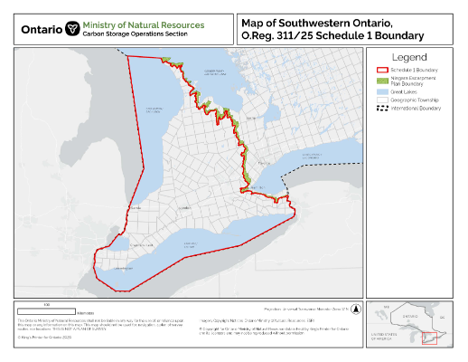
While the pore space underlying private lands on the Ontario Peninsula may not be available for an eventual public tender, the beds of the surrounding navigable waters—including Lake Erie, Lake Huron, and Lake St. Clair—are presumed to be owned by the Crown7. The pore space underlying those lakes, including within the prospective Cambrian-aged sandstone reservoirs of the Mt. Simon Formation and its equivalents, may therefore attract expressions of interest and ultimately be made available for public tender.
Expressions of interest
As noted, the present call for expressions of interest is a precursor to a “Minister’s invitation” required for proponents to apply for a research and evaluation licence or a storage licence for commercial operations. The Ministry of Natural Resources is not seeking detailed project proposals at this stage. Rather, the response form provided by the Ministry requests high-level information across ten subject areas: project overview, operational capacity, location, configuration and execution, risk identification, business model, Indigenous engagement awareness, regulatory awareness, data availability, and industry challenges and opportunities.
The details requested in this response form nevertheless suggest that the province expects proponents to have completed a significant amount of site screening and initial project planning to participate at this stage. Among other things, proponents are asked to describe their proposed project concept and anticipated scale, including the lead organization and the roles of any partners or consortium members. They must also speak to their operational capacity, including relevant technical, operational, and project delivery experience with CCS, subsurface activities, or energy infrastructure. Importantly, proponents are expected to identify their proposed area or areas of interest and the technical and geological bases for those locations.
The response form also requires proponents to outline their development approach, key milestones, major project components, and infrastructure requirements, along with anticipated timelines and dependencies. Respondents are to identify the main risks and uncertainties, as well as their anticipated business model, including projected costs, potential sources of carbon dioxide, and revenue or funding sources. Taken together, these requirements indicate that the expression-of-interest process will test industry readiness to advance commercial-scale CCS projects in Ontario and, relatedly, the attractiveness of the province’s emergent legal framework for CCS.
Conclusion
Given the predominance of private pore space ownership beneath the Ontario Peninsula in the southwest corner of the province, the Crown-owned pore space in reservoirs beneath the lakebeds bordering the Peninsula are perhaps the most prominent candidates for expressions of interest.
The expression-of-interest guidelines reflect an expectation that participants have advanced their project ideas well beyond the initial conceptual stage. Notwithstanding the Ministry’s characterization of the expressions-of-interest process as a non-binding information-gathering exercise, it may in practice operate as an advance screening mechanism for an eventual request for proposals. Interested parties should therefore treat the submission process accordingly to position themselves for a future competitive process under the GCSA.
- Ontario, Geologic Carbon Storage Act, 2025 (GCSA), Statues of Ontario (SO) 2025, chapter 17, schedule 2.
- Ontario Regulation (O Reg) 311/25; O Reg 12/26; O Reg 13/26.
- O Reg 12/26, section 4.
- GCSA, section 7.
- GCSA, section 8.
- Ettinger et al., The Pore Space Race: Conflicts of Subsurface Rights in the Age of Carbon Capture and Sequestration, Alberta Law Review (2025) 63:2 at pp 7-8.
- Chippewas of Nawash Unceded First Nation v Canada (Attorney General), 2023 ONCA 565 at para 91 and Beds of Navigable Waters Act, RSO 1990, chapter B.4.
Tags
Inscrivez-vous pour recevoir les dernières nouvelles
Restez à l’affût des nouvelles d’intérêt, des commentaires, des mises à jour et des publications de Torys.
Inscrivez-vous maintenant