The 2020 U.S. election: what’s at stake?
Authors





The extraordinary events of 2020 have amplified the profile of what was already expected to be a historic U.S. election. The pandemic and its many effects on the global economy and international relations loom large over both a turbulent America and its trading partners, including Canada.
Cross-border M&A: 2020 activity and regulatory outlook
M&A dealmaking experienced a sharp decline earlier this year as a result of the pandemic, though some deal activity has resumed heading into the last half of the year1. We have seen U.S. investment into Canada drop significantly in both deal volume and value (see Figure 1).
Figure 1 - U.S. investment in Canada
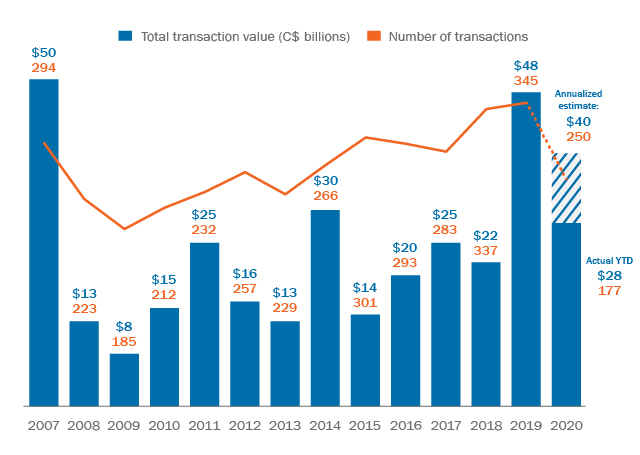
Source: Bloomberg. Based on pending, announced or completed M&A transactions. Figures current to September 15, 2020.
Meanwhile, Canadian investment into the United States also suffered as a result of the pandemic, though year-over-year activity in terms of volume saw a slightly softer decline (see Figure 2). While “southbound” cross-border dealmaking has slowed this year, deals continue to get done, though transaction sizes are substantially smaller on average than other recent years.
Figure 2 - Canadian investment in the U.S.
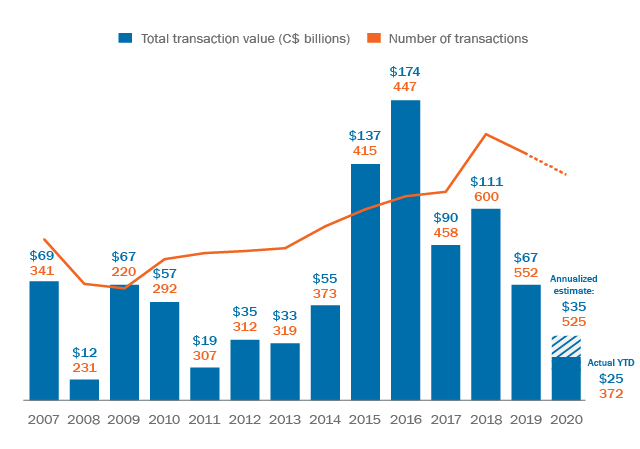
Source: Bloomberg. Based on pending, announced or completed M&A transactions. Figures current to September 15, 2020.
Against this backdrop, and with the U.S. elections just around the corner, we look at some of the issues at stake in the election and how they may affect business between the U.S. and Canada. Of course, these issues turn not only on the outcome of the presidential elections. Even if Biden ascends to the presidency, most of his campaign proposals are not likely to be implemented unless both houses of the U.S. Congress have a Democratic majority.
Regulatory environment generally
One of the defining features of the Trump administration has been a reduction of bureaucratic process and regulation related to business. As discussed below, the Trump administration has also aggressively leveraged the CFIUS regime, particularly with regard to Chinese investment in U.S. technology companies, to enforce the administration’s policy goals.
While specifics remain unknown on how a Biden administration might approach regulation of M&A processes in the United States, it is conceivable that it will bring a new level of empowerment for regulators in managing the economy—particularly in traditional areas of Democratic concern such as environmental regulation, healthcare and labor.
With that might come a desire for increased regulatory scrutiny, more disclosure and transparency expected from transacting companies, as well as a higher diligence burden corresponding to increased regulatory risk in areas that the Trump administration has been less focused on regulating.
Tax
Tax is a point of notable difference for the two presidential candidates and their parties. While many U.S. businesses have benefited from President Trump’s Tax Cuts and Jobs Act, Biden has announced an ambitious tax plan that would make a variety of changes to that legislation.
Key to Trump’s Tax Cuts and Jobs Act was decreasing the corporate tax rate to 21% from 35%. Biden has said he’d meet that difference halfway, with a proposed increase to 28%. This change, if enacted, could have significant impact on U.S. businesses’ cashflow and, accordingly, on Canadian businesses or investors looking to invest south of the border.
Biden has also announced plans to significantly increase taxes on high earner individuals. He would increase the top tax rate for compensation and ordinary income from 37% to 39.6% and increase the tax rate on long-term capital gain and qualified dividends from 20.0% to 39.6% for such individuals, a change that some expected would be a catalyst to M&A activity in 2020 as business owners seek to exit before rates go up. However, it is difficult to ascertain to what extent that expectation has been borne out given deal volume and value numbers for 2020 have been materially impacted by the pandemic.
To reiterate, as with other Biden proposals, any significant tax changes will require that Democrats retain control of the U.S. House of Representatives (which is expected) and take control of the Senate (which is uncertain).
CFIUS and foreign investment
The Trump administration has been targeting Chinese ownership of and investment in technological applications that collect the personal data of U.S. persons (President Trump’s approach to video-sharing app TikTok is the latest high-profile example)2. To do this, the administration has been leveraging the Committee on Foreign Investment in the United States (CFIUS) in its role to safeguard U.S. national security concerns related to foreign investment.
In the near term, Canadian investors should consider CFIUS oversight over similar technology and data-intensive businesses, particularly when in connection with Chinese investment. CFIUS’s focus on China, however, presents Canadian investors, many of whom are currently deemed “excepted investors” relieved of certain CFIUS requirements, with opportunities to facilitate their investments in the United States.
While it remains to be seen whether CFIUS will continue to play an outsized, and politicized, role in the event the upcoming U.S. election results in a change of administration, scrutiny of Chinese investment in the U.S. accelerated under former President Obama and, therefore, can be expected to remain a bipartisan priority well into the future.
The energy sector and climate change
If elected, Joe Biden appears set to invest more in renewable energy infrastructure and in particular has said that he would oppose the Keystone pipeline project from moving forward. Altogether this could have a further chilling effect on the state of oil and gas industry, not just in the United States, but also in Canada, where support for key pipelines between the two countries is widely seen as a critical step for improvement of Canada’s long-beleaguered oil and gas sector. While projects will still likely have a path forward, approach to energy resources and investment in the United States will likely change under a Biden presidency.
Private equity
During the economic crisis created by the pandemic, private equity sponsors have increased their focus on distressed investments, seeking to capitalize particularly on assets that may be in temporary distress3. Similarly, they have pivoted to sectors that have weathered the crisis well, including healthcare, biotech and renewables. We would expect these trends to continue irrespective of the outcome of the U.S. elections.
As mentioned above, Biden’s tax plan contemplates raising corporate taxes to 28% and the corresponding decrease to corporate cash flows may negatively impact company valuations, including for PE-owned businesses.
Likewise, Biden’s plan to increase the long-term capital gains tax rate could well inform the timing of exit transactions for PE-owned companies, assuming the larger pandemic environment doesn’t get in the way.
Private equity sponsors have long been wary about how a Democratic trifecta in Washington D.C. would treat their carried interests. While Biden’s tax proposals do not expressly comment on eliminating the current tax treatment for carried or profits interests, Biden has proposed an increase to the long-term capital gain rate for those earning more than $1 million. That, in essence, has the effect of taxing carried interest at ordinary income tax rates. If enacted, these changes may result in private equity firms revising their investment models, and that in turn could have broader implications on valuations for transaction participants.
Infrastructure
While Biden’s current stated plan for infrastructure is relatively light on details, he has committed to investing $2 trillion during his first term on modern, sustainable infrastructure and clean energy. His infrastructure plan focuses on expected sectors, including roads, water systems, municipal transit networks and universal broadband access, but also on areas outside the traditional definition of infrastructure. For example, the Biden plan would create incentives to upgrade residential and commercial buildings to make them more resistant to extreme weather and would fund research and development in precision agriculture.
Biden’s infrastructure plan is linked to his promises related to combatting climate change and rebuilding the American middle class. One of the stated goals is to create millions of new union jobs building and upgrading American infrastructure. On this basis, companies benefitting from his infrastructure and clean energy investments will need to meet the labor protections in Senator Merkley’s Good Jobs for 21st Century Energy Act, applying and strictly enforcing Davis-Bacon prevailing wage guidelines.
Despite broad bi-partisan support for investment in infrastructure and Trump’s 2016 campaign promises related to infrastructure, lawmakers in Washington have been unable to agree on an infrastructure bill during Trump’s tenure. Trump’s infrastructure plans have typically focused on transportation, broadband infrastructure and U.S. energy independence. Trump has emphasized reducing regulatory barriers and streamlining permitting processes for infrastructure projects as key components of his approach. He has also supported using a limited amount of federal funding to leverage more state, local and private funding for infrastructure.
Regulation of Big Tech
Big Tech has ended up in the political spotlight for a number of reasons: allegations of monopolistic practices, controversial use of data and privacy policy; the role of Big Tech in regulating free speech and the spread of misinformation are among those issues. As we look forward, these issues are likely to remain part of political debate—although neither Trump nor Biden have made specific statements suggesting that breaking up Big Tech or enhancing their regulation are top priorities in their platforms.
Conclusion
In a year marked by instability, and government response to the pandemic in countries around the world, the outcome of the U.S. election will be felt throughout the business community and may well end up impacting how businesses evaluate, negotiate and close transactions. Canadian businesses and U.S. companies with business in Canada will want to consider how they will adapt their cross-border strategies to the outcome of this historic election.
_________________________
1 “Global M&A rebounds in Q3: Refinitiv”, Investment Executive. August 31, 2020. Available here.
2 “Taking on TikTok: CFIUS on the front page (and in the fine print)”, Torys bulletin. September 21, 2020. Available here.
3 “Current observations of COVID-19’s impact on private fund sponsors and limited partners”, Torys bulletin. May 29, 2020. Available here.
Le mois dernier, le Canada a publié sa première Stratégie industrielle de défense (la Stratégie), qui souligne l’engagement du Canada à développer une base industrielle de défense solide et à stimuler la croissance économique. Ces efforts pourraient aussi comprendre le renforcement de l’état de préparation à la biodéfense et aux contre-mesures médicales, ce qui pourrait constituer des débouchés pour le secteur canadien des sciences de la vie en raison de l’importance accordée aux capacités nationales en ce sens et de la nécessité d’atténuer les risques d’urgences sanitaires.
Développement de contre-mesures médicales au Canada
Comme indiqué dans les bulletins précédents, le quatrième pilier de la Stratégie est axé sur la « sécurisation des chaînes d’approvisionnement pour les intrants et les biens clés » par le renforcement de la production nationale et le stockage de ressources. L’accent est mis tout particulièrement sur les contre-mesures médicales, en précisant que nos « alliés ont établi un lien explicite entre l’état de préparation à la biodéfense et aux contre-mesures médicales et leur sécurité économique et nationale, en élaborant de nouvelles stratégies et de nouveaux mécanismes pour faire progresser ces travaux ». Les contre-mesures médicales désignent divers produits réglementés pouvant être utilisés pour protéger la population lors d’une situation d’urgence de grande ampleur, comme l’éclosion d’une maladie ou une attaque impliquant des armes chimiques, biologiques ou nucléaires. Il peut s’agir de vaccins, de médicaments thérapeutiques et produits biologiques, de dispositifs de tests diagnostiques, des équipements de protection individuelle ou industrielle, et d’autres dispositifs médicaux. Les contre-mesures médicales sont essentielles à la réduction et à l’atténuation des dommages lors d’une urgence de santé publique.
Exploiter les voies réglementaires mises en place lors de la pandémie de COVID-19
Pendant et après la pandémie de COVID-19, le Canada a mis en place plusieurs nouvelles voies réglementaires comme mécanismes d’accélération des approbations de produits médicaux, ce qui pourrait offrir au gouvernement des options pour déployer des contre-mesures médicales afin de faire face aux risques pour la santé publique. Au début de la pandémie, Santé Canada a émis diverses ordonnances provisoires pour permettre l’importation et la vente de médicaments et de dispositifs médicaux qui n’avaient pas eu l’approbation des voies réglementaires traditionnelles. Or, Santé Canada a plutôt fait confiance aux voies d’approbation réglementaire et de l’exemption de certaines exigences en homologation de produits des pays impliqués dans la transaction. Beaucoup de ces règles provisoires ont depuis été officiellement intégrées à la réglementation en vertu de la Loi sur les aliments et drogues et ont été appliquées bien après la COVID-19. Conformément au Règlement sur les aliments et drogues, Santé Canada tient à jour la Liste des maladies qui menacent la santé publique et utilisera une procédure d’autorisation modifiée pour les médicaments d’urgence de santé publique pouvant traiter les affections figurant sur la liste. De même, le Règlement sur les instruments médicaux a établi une liste d’instruments médicaux répondant à un besoin urgent de santé publique, ce qui permet à Santé Canada d’autoriser la commercialisation de ces instruments de manière accélérée. Ces outils réglementaires sont utilisés automatiquement quand une situation médicale présente un grand risque pour la santé publique au Canada et nécessite une action immédiate pour contrer ce risque.
Le rôle de la Stratégie dans le renforcement du régime réglementaire de la santé au Canada
La stratégie prévoit que le Canada adoptera une approche proactive en matière de planification en amont des crises sanitaires. Le gouvernement entend s’assurer que les produits médicaux sont déjà disponibles au Canada afin qu’ils puissent être distribués rapidement en cas d’urgence. D’autres modifications récentes au Règlement sur les aliments et drogues permettent de prépositionner au Canada tous les médicaments d’urgence en santé publique, ce qui signifie qu’ils peuvent être importés dans des installations d’entreposage canadiennes avant que leur mise sur le marché n’ait été autorisée. La Stratégie s’appuie sur ces fondements, en faisant référence à l’organisme existant Préparation aux crises sanitaires Canada (PCSC), un organisme opérationnel spécial au sein d’Innovation, Sciences et Développement économique Canada (ISDE), et à un nouveau Fonds des sciences de la vie, lesquels « collaborent avec des partenaires internationaux et de soutenir l’élaboration et la production de contre-mesures médicales ». PCSC supervise la Stratégie en matière de biofabrication et de sciences de la vie du Canada, qui vise à développer un secteur national des sciences de la vie fort et compétitif doté de capacités de biofabrication de pointe, en mettant l’accent sur la capacité à se préparer et à faire face aux futures priorités et crises sanitaires. Dans cette optique, il y aura des occasions pour les fabricants de nouer des collaborations de recherche et des accords commerciaux ou d’approvisionnement liés aux contre-mesures médicales financées par des programmes fédéraux.
Étroitement lié aux capacités nationales, le pilier III de la stratégie implique « Investissement ciblé pour renforcer un secteur canadien de la défense novateur », avec la promesse que le gouvernement fédéral « soutiendr[a] la recherche et le développement, protéger[a] la propriété intellectuelle, soutiendr[a] les petites et moyennes entreprises, investir[a] dans les compétences et la formation, et encourager[a] les exportations afin de créer un secteur de la défense agile et concurrentiel à l’échelle mondiale ». La nécessité de favoriser le développement de la propriété intellectuelle (PI) et la conservation des droits du Canada est mentionnée à plusieurs reprises dans la Stratégie. Par exemple, la Stratégie prévoit l’établissement de partenariats officiels avec l’industrie canadienne qui « [assureront] la propriété et le contrôle nationaux de la propriété intellectuelle (PI) et des capacités essentielles. » La Stratégie reconnaît l’immense talent des établissements canadiens et la précieuse recherche qui y est menée actuellement et qui est déjà financée par des subventions de recherche d’organismes tels que le Conseil de recherches en sciences naturelles et en génie et les Instituts de recherche en santé du Canada, et fait aussi référence à l’engagement de 1,6 milliard de dollars pour de nouveaux fonds de recherche dans le budget de 2025. Cette prise de conscience de la nécessité de promouvoir et de soutenir l’innovation au Canada laisse présager des possibilités de financement, notamment dans les domaines où le Canada accuse un retard en matière de production nationale et où des engagements d’investissement et de fabrication au Canada peuvent être pris.
Prochaines étapes
Dans les prochains mois, nous prévoyons que le gouvernement du Canada publiera d’autres directives et des mesures de suivi. L’équipe de défense des conservateurs poursuivra sa couverture de perspectives sur la défense au Canada en publiant une analyse supplémentaire pour donner des précisions sur l’incidence de la Stratégie sur de multiples secteurs.